ASCRS News: 2021 ASCRS Annual Meeting
September 2021
by Ellen Stodola
Editorial Co-Director
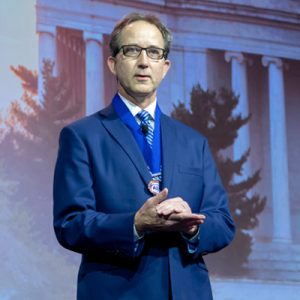
Vance Thompson, MD, and John Berdahl, MD, moderated “The Winning Pitch Challenge” at the ASCRS Annual Meeting. The challenge gives ophthalmologist entrepreneurs the opportunity to share tomorrow’s innovative ophthalmic solutions with leading experts in the field. Dr. Thompson founded this program with John Pollack, MD, and David Williams, MD, several years ago and pitched it to ASCRS to include on the Annual Meeting program.
Dr. Thompson said submissions for this symposium come from around the world. Submitters that qualify are paired with a mentor to help develop their pitch decks, just like they are going to pitch to an investor group, Dr. Thompson said. Several months before the meeting, the pitch decks are scored by judges. This score determines the submissions that are deemed honorable mentions and finalists, who present during the ASCRS Annual Meeting symposium.
Three candidates presented their 5-minute pitches, followed by a series of questions from judges. Winners received cash prizes and guidance on how to operationalize their concept. More details on the Winning Pitch Challenge can be found at winningpitchchallenge.net, and there are plans for a symposium at next year’s ASCRS Annual Meeting in Washington, D.C. Judges this year were Jim Mazzo, William Link, PhD, and Richard Lindstrom, MD.

Source: ASCRS
Squid Glaucoma Shunt: Karanjit Kooner, MD, PhD
With glaucoma being the second leading cause of blindness worldwide, the magnitude of the problem is apparent, Dr. Kooner said.
Dr. Kooner listed a number of issues with current glaucoma drainage devices, including large plate sizes, high risk of post-surgical fibrosis, and the fact that they require extensive tissue dissection. Outflow of aqueous humor with current devices is unpredictable and uncontrolled, he said.
Dr. Kooner’s solution is the Squid Glaucoma Shunt, which he said will transform the market. Its disc size is 90% smaller than current glaucoma drainage devices; it fits with two retainers for device stability and to eliminate suturing of the implant; the outlet port is fenestrated and coated with mitomycin-C; it uses superhydrophobic ultrananocrystalline diamond (UNCD) coating; and there is a valve complex for controlled aqueous humor flow. Early data showed propensity to significantly reduce IOP. He also mentioned controlled release of aqueous humor with this new shunt.
Dr. Kooner noted that it would be about a $700 savings per surgery and about a 50% reduction in surgical time compared to current glaucoma drainage devices. He is aiming to have a prototype by the end of the year and to conduct clinical trials by the end of 2022. Dr. Kooner requested $3 million in investments.
JelliSee IOL: Jim Ellis, MD
Cataract removal is the most common surgical procedure performed in the world, Dr. Ellis said, with 36 million surgeries per year estimated by 2025. The problem, he said, is that IOLs do not correct presbyopia. Though there are many “solutions,” Dr. Ellis said that none are ideal.
The JelliSee IOL provides restorative lens surgery (RLS). He called accommodating IOLs the “holy grail of ophthalmology innovation.” The JelliSee lens is a “dis-accommodating” design that is based on three observations of the natural pediatric lens, he said. The first is the gradient elastic index; the lens capsule of a child is 2,000 times stiffer than the much softer peripheral cortex and even softer lens nucleus. The second observation is on selective zonular force. Using a model lens, a radial force applied 500 microns anterior to the equator results in 5 more diopters of power change than the same radial force applied at the equator itself. The third observation is logarithmic dioptric power change, whereby a flatter initial surface produces greater dioptric power change per millimeter of diameter increase.
The JelliSee IOL has a relatively firm, but flexible, and relatively flat anterior surface; is a liquid-filled lens and the haptics apply tensile force to the anterior surface; it does not rely on retained capsular elasticity; and the eight-haptic design optimizes optical quality.
Dr. Ellis said the proof of concept has been demonstrated with bench testing, and studies have just begun in primates. Human trials are planned to start this fall/winter. Dr. Ellis was seeking $5 million in investments.
Light-field exam: Chip Berestka, MD
The slit lamp exam hasn’t changed in 75 years, Dr. Berestka said, introducing the light-field exam. Light-field optics is a new branch of photography that can image a 3D cube of space permitting after-the-fact focusing. He said it would have selective focus, all-in focus, and perspective-changing 3D. To recreate the slip lamp exam after the fact, a technician would capture light-field images as a slit traverses the eye in the X axis to create a library of images. The doctor could then later “drive through” the slit lamp exam in his or her own sequence on a computer or smartphone. How would this change ophthalmology? Dr. Berestka said the slit lamp could be acquired by the technician. The doctor could then review the exam with the patient, pointing out pathology at the same time. There’s no wasted time at the slight lamp, he said, and it will also integrate into the EMR system. This technology, he said, is ideal for postop and brief visits, and it frees up time for surgery. The system would help make telemedicine possible for ophthalmology.
Dr. Berestka added that the market for this product is large. He expects prototype development in a year and full production in 2 years. He asked for $5 million and was also seeking talent for the board of directors and medical advisory board.
ARTICLE SIDEBAR
First place: $25,000
Jim Ellis, MD
Second place: $15,000:
Chip Berestka, MD
Third place: $5,000
Karanjit Kooner, MD