
Glaucoma
March 2021
by Liz Hillman
Editorial Co-Director
Durysta, the sustained-release bimatoprost implant, 10 mcg (Allergan), has been available with FDA approval in the U.S. market for a year now. EyeWorld spoke with two physicians, Amy Mehta, MD, and Joseph Panarelli, MD, who started offering it as an option to their patients to hear about their experience thus far.
Early experiences
Both Dr. Mehta and Dr. Panarelli said the patients who have received Durysta in their practice have had a good response to it. They are not necessarily offering it extensively but are trying to figure out where it fits in the treatment algorithm.
“I’m trying to find the right place for it in my treatment regimen. … We have so many different treatment modalities available to us. It’s hard to figure out what is the best option for each person sitting in front of us,” Dr. Panarelli said.
Good candidates
Dr. Panarelli said there are two groups of patients for whom he is finding Durysta to be most helpful: 1) those with ocular surface disease and 2) those with compliance issues.
“There are a good number of patients who have issues with topical medications, either the preservatives or the medication itself irritates the ocular surface. … Even for a period of 6 months to a year, if we can get them off topical therapy and improve their surface, that’s a big win for us,” he said.
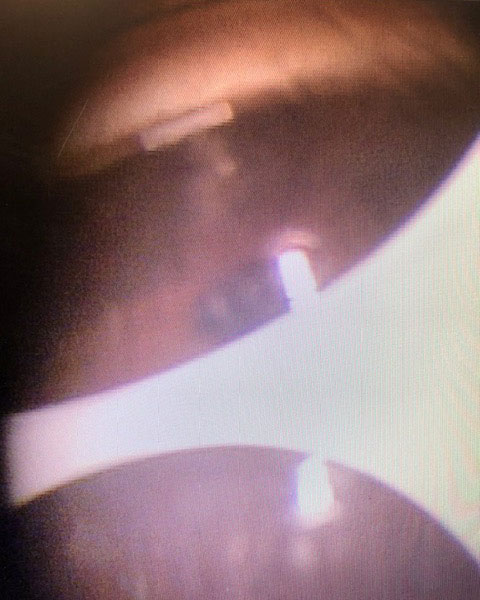
Source: Amy Mehta, MD
Those who have issues with compliance might be forgetting their drops or have trouble administering them physically. Dr. Panarelli also said he’s had a small number of other patients who are benefiting from Durysta during the pandemic.
“I have a handful of patients who, given the pandemic, aren’t excited about the idea of having surgery because of the many postoperative visits required. [Durysta] has been a nice bridge, a treatment option to put off or delay more invasive surgical interventions,” he said.
Dr. Mehta thinks Durysta could also be an interesting option for cataract surgery patients who have glaucoma. Due to the number of drops associated with cataract postop routines, she said that taking away a glaucoma drop by using the sustained-release implant can be helpful in this timeframe. She also found it useful for a patient of hers who was undergoing chemotherapy.
“She’s going to be on a lot of medications for the next few months and this is a way to ease her burden by taking something out of her life that she doesn’t have to remember,” Dr. Mehta said.
Dr. Mehta said she tries to use Durysta on patients who have already shown they respond to bimatoprost or another prostaglandin analog.
“It’s nice for me to know they’ve had a good response to that medication,” she said, adding that one patient was given Durysta as a first-line therapy after she tried him for a couple of weeks on Lumigan (bimatoprost, Allergan) to determine his response.
Reimbursement
Dr. Mehta said patients need to have Medicare plus a secondary insurance, with the secondary insurer being one of the larger companies.
“The process for signing someone up for Durysta has been lengthier than SLT or something like that. Typically, I talk to the patient about it, they fill out a form, we call them after it’s been approved, then we schedule it for them,” she said.
Patient hesitation
Dr. Panarelli said that some patients are initially weary of having an injection in their eye, but with a little more explanation, many become more comfortable.
“The majority of patients after the procedure is done find it was a rather easy experience,” he said.
Dr. Mehta hasn’t had any patients who expressed fear of the injection.
Administering the implant
Dr. Mehta said all of her Durysta injections have been done at the slit lamp or in a minor procedure room at her office. She said that you can get approved to do it at an ASC, but she has not yet performed it on any patients at an ASC.
Dr. Panarelli also said he has been injecting Durysta in the office at the slit lamp.
What’s next?
“I think that if you’re taking care of glaucoma patients, you want something that will help them in the long run. Durysta isn’t giving them that complete lifetime coverage but it does help us in improving quality of life even temporarily,” Dr. Mehta said, adding that there are studies being done to look at multiple or longer lasting sustained-release of Durysta.
Currently, one Durysta implant is designed to last several months, but a Phase 1/2, dose-ranging study found that one Durysta implant controlled IOP in 40% of patients for up to 12 months and 28% of patients for up to 24 months.1 A Phase 3 study designed to evaluate different doses and up to three implants found that IOP was controlled at 1 year.2
Dr. Panarelli said it’s great to have a new product, and he thinks with more time physicians will begin to see where it fits into their individual treatment regimens.
“One of the questions many of us continue to ask is how far will this go? Should we use this product first line? Second line? We just don’t know yet,” he said, adding later that if real-world use demonstrates the safety and efficacy seen in the trials, he thinks use of Durysta will expand.
About the physicians
Amy Mehta, MD
SightMD
New York, New York
Joseph Panarelli, MD
Chief of the Glaucoma Service
New York Langone Health
New York, New York
References
- Craven ER, et al. 24-month phase I/II clinical trial of bimatoprost sustained-release implant (bimatoprost SR) in glaucoma patients. Drugs. 2020;80:167–179.
- Medeiros FA, et al. Phase 3, randomized, 20-month study of bimatoprost implant in open-angle glaucoma and ocular hypertension (ARTEMIS 1). Ophthalmology. 2020;127:1627–1641.
Relevant disclosures
Mehta: None
Panarelli: Allergan
Contact
Mehta: amehta@sightmd.com
Panarelli: joepanarelli@gmail.com