EXTENDED EDITION
ASCRS News
July 2021
Nancey McCann served as ASCRS director of Government Relations for 28 years. After retiring from the role at the end of March, Ms. McCann remains a consultant for ASCRS, working on several key initiatives.

Ms. McCann reflected on some of the major issues ophthalmology and ASCRS faced during her career serving the society and how ASCRS came to have a seat at the table in legislative and regulatory matters.
Prior to ASCRS, Ms. McCann worked at several trade associations, always in a government relations capacity. In 1993, ASCRS created a new position, director of Government Relations.
“The feeling of the leadership at the time was that they needed a dedicated person to represent anterior segment surgeons,” she said, noting that the society had a Government Relations Committee when she came on board. Through the years, she’s worked with many chairs of this committee, including Jack Dodick, MD, John Hunkeler, MD, Paul Arnold, MD, Priscilla Arnold, MD, Brock Bakewell, MD, and Parag Parekh, MD.
Building a relationship on Capitol Hill and with the medical community
While ASCRS is now very involved on Capitol Hill, Ms. McCann said there was virtually no consistent presence when she started. The organization didn’t regularly lobby or participate in the regulatory process, and it wasn’t involved in any coalitions.
But as Ms. McCann began to develop relationships on the Hill and within the medical community, including with the American Academy of Ophthalmology, this involvement grew. Ms. McCann began regularly going to Capitol Hill, became familiar with key members of Congress and staff, and brought important information about the society and ophthalmology, in particular cataract surgery, to their attention.
“There was a misconception that it was a quick and easy procedure,” Ms. McCann said. It was important to explain the complexities of the procedure and even demonstrate cases in the OR where Hill staff could get an appreciation of the difficulty of the surgery as well as the equipment and supplies that were necessary. This was at the same time the resource-based relative value scale (RBRVS) was implemented, and surgical reimbursement was slated to go down.
In 1993, Bill Clinton was president, and healthcare reform was a major issue. The majority of physicians were not involved in the political process at that time. “I think they got a wakeup call, and I saw a real difference in physicians understanding the need to be more involved in the political process,” she said.
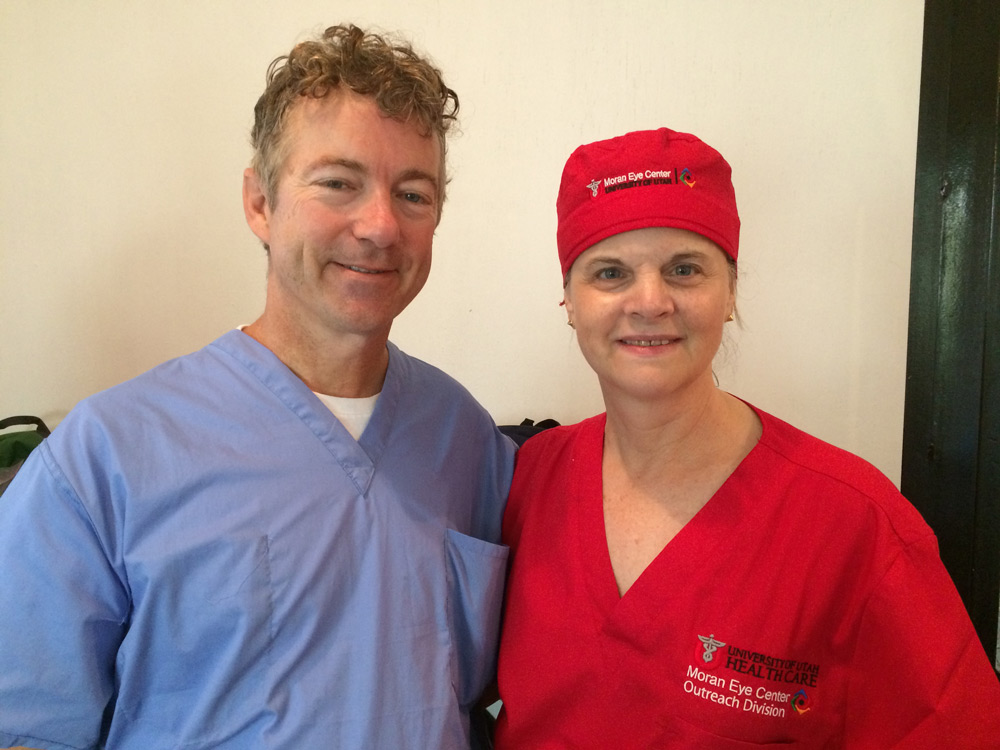
Over time, more physicians began to run for Congress, Ms. McCann said. Now there’s a Doctors Caucus in the House, she said, adding there is one ophthalmologist in the Senate, Rand Paul, MD, (R-KY), and there have been several ophthalmologists serving in the House, currently Mariannette Miller-Meeks, MD (R-IA).
Ms. McCann developed an ASCRS grassroots program and members became involved. eyePAC, the first PAC in ophthalmology, had already been established by ASCRS, but Ms. McCann and her team made sure that focused contributions were made to key congressional members who served on health-related committees and delivered by ASCRS member physician constituents with a focus on ASCRS’ priority issues. Grassroots communications to ASCRS members encouraged the development of relationships with their congressional representatives.
Source: Nancey McCann
Collaborative efforts
A push to move patients into managed care plans prompted concerns throughout the medical community about patient access to specialty care. “We formed the Patient Access Coalition because managed care was becoming the biggest threat to patient access to specialty care,” Ms. McCann said. This coalition included more than 100 provider and patient groups. “We were fighting for legislation that would mandate an out-of-network option for every managed care plan, and as a result of our efforts, bipartisan legislation was introduced in the House and Senate,” she said. Ms. McCann eventually became co-chair of this coalition.
As a result of these efforts and George W. Bush’s interest in the issue, representatives of the coalition were invited to meet with President Bush and his administration.
“Typically, the Hill and administration, as well as large groups like the American Medical Association, looked toward major umbrella organizations to gain information and input, but through our proactive efforts, we gained a presence on the Hill and with the rest of the medical community. As a result, and even though we are a subspecialty, ASCRS gained a seat at the table, which continues to this day,” Ms. McCann said.
“We started forming coalitions on an as-needed basis when different issues arose,” she said, explaining that these coalitions helped consolidate efforts. Working in coalitions is vital, she added, because it’s rare any one organization can do it on its own. Being able to work collaboratively with like-minded organizations is extremely important and impactful.
ASCRS was also instrumental in forming the Alliance of Specialty Medicine, a coalition of 14 medical specialty organizations, to stay connected with like-minded specialties with the focus on continued access to specialty care, Ms. McCann said. In addition to its involvement in the legislative and regulatory areas, the Alliance holds an annual legislative fly-in, which is an opportunity for members to lobby members of Congress on the Hill.
The RBRVS and concerns over cuts
When Ms. McCann first started at ASCRS, RBRVS had just begun to be implemented. The work values were already in place, and practice expense was being implemented. “With many of the ophthalmology procedures, the practice expense relative value units (RVUs) typically exceed the work RVUs, so that became a major concern,” she said.
Ophthalmology was significantly impacted, as was the majority of the surgical specialties because the goal of RBRVS was to redistribute money from surgical specialties to primary care, Ms. McCann said. So it became imperative to work with like-minded organizations, and another coalition was formed. “Legislation was introduced and implemented, as a result of our work with the Practice Expense Coalition, that changed the methodology for phasing in practice expense, which resulted in a more favorable outcome,” Ms. McCann said.
A medical procedure patent issue
Ms. McCann recalled the efforts to prevent an ophthalmologist from suing another for a supposed violation of a medical procedure patent that he received on a cataract incision and enforcing it against ophthalmologists.
This required efforts from ASCRS to get legislation introduced and signed into law, as well as invalidating the patent.
Ms. McCann considered this to be a “white hat issue, not focused on reimbursement, but patients,” and after getting support from the American Medical Association and the American College of Surgeons, a coalition was formed with the surgical specialties. “These fees would be imposed on physicians, which would ultimately have a negative impact on the patient,” she said.
As a result, bipartisan legislation was introduced by Sen. Bill Frist, MD (R-TN), and Rep. Greg Ganske, MD (R-IA), as well as Sen. Ron Wyden (D-OR), who was then a member of the House of Representatives. After a major grassroots effort, the legislation, which eliminated remedies against physicians for infringement of a medical procedure patent with a few exceptions, overwhelmingly passed and was signed into law with the clear message that physicians do not “invent” procedures or incisions; they stand on the shoulders of others before them.
“ASCRS went to court to defend the physician who was being sued, and the patent was overturned,” Ms. McCann said.

Source: Nancey McCann
The SGR and moving to MACRA/MIPS
Another key issue that permeated through years of Ms. McCann’s career was the sustainable growth rate formula (SGR) and its impact on Medicare physician reimbursement. “As RBRVS was being implemented, there was a control on the utilization of services built into this formula, the value performance standard,” she said. It was a year-to-year target based on several factors, including the utilization of physician services. During that time, there were three separate conversion factors with separate utilization targets, she said, with primary care, surgery, and other services each having their own separate conversion factor.
If you went over the utilization target, which was based on several factors including the GDP and the Medicare Economic Index (MEI), there was a reduction the following year to that conversion factor, Ms. McCann explained. Surgery always fell below the target, but primary care was facing reductions because they continued to go over the target. “Surgery was receiving significant updates to the conversion factor,” she said, with one year around 10%. As a result, it offset the cuts that were occurring at the time with the implementation of practice expense and RBRVS.
However, Ms. McCann said things changed when primary care pushed back, and it ultimately became one conversion factor. The Value Performance Standard eventually became the SGR formula in 1997, a cumulative formula rather than year to year.
Ms. McCann said eventually all physicians were facing a potential 5% cut to the conversion factor under the SGR, which was significant. Congress kept preventing the cuts, but they wouldn’t spend the money to fill up the hole that was created as a result of the cumulative nature of the formula, Ms. McCann explained. “Each year, they were only putting enough money to go on to the next year, and it kept accumulating where we’d be faced with significant reductions reaching 25% in one year,” she said. Finally, in 2015, the Medicare Access and CHIP Reauthorization Act of 2015 (MACRA) was signed into law to replace the SGR and implement a new system tying reimbursement to quality and efficiencies, the Merit-based Incentive Payment System (MIPS) and Advanced Alternative Payment Models (APMs).
As Ms. McCann put it, Congress indicated it didn’t want to pay physicians the same for each CPT code, regardless of how successful the outcome and quality and the cost to provide the care, so it created MACRA, which included the Quality Payment Program (QPP). They included an additional payment incentive to move physicians from fee for service into Advanced Alternative Payment Models. Now the way updates occur, in addition to budget neutrality, is based on the QPP, which includes quality, cost, improvement activities, and promoting interoperability. Physicians can get a bonus or reduction.
CMS intentionally made it easy to participate in the MIPS program at the beginning so practices could get used to it, Ms. McCann said. Because the majority of physicians were successful and have not been penalized and it’s budget neutral, there’s not much money to fund the bonuses, except for the exceptional performance bonus. As a result, Ms. McCann said, the bonuses have not been that significant, which isn’t a big incentive.
The intent is to continue to move Medicare reimbursement to a system that is quality- and outcome-based because the ultimate goal of CMS is for physicians to move from fee for service to alternative payment models, she said. There will be many challenges moving forward, including the continued threat of cuts to surgical and specialty care, and the Surgical Coalition, of which ASCRS is a member, is looking into possible changes to the Medicare physician payment system and the formula that is used to reimburse physicians. Ms. McCann said the perception continues that primary care is not appropriately reimbursed, which is an obstacle moving forward.
Growing the department and its use for members
In addition to representing the membership on Capitol Hill and with the administration, Ms. McCann and ASCRS Government Relations strove to provide members with up-to-date, accurate information by creating Washington Watch Weekly and to be available to answer their questions to improve the success of their practices. She also encouraged involvement with ASOA and practice administrators, those responsible for implementation of many government regulations and reimbursement measures. The administrators running the practices understand the impact that Medicare and reimbursement rules and regulations have on their practice, she said. “Ophthalmology relies on Medicare reimbursement more than any other specialty,” she said.
While it’s important for members to understand issues that may impact their individual practices and patients, Ms. McCann said it’s also important for them to understand how they can make a difference by getting and staying involved.
Moving forward
The difficult situation of the COVID-19 pandemic made advocating and working on legislation and regulatory issues all the more challenging. In her 28 years, Ms. McCann said she hasn’t seen anything that compares to the past year.
Cataract surgery in particular was one of the most impacted elective procedures, she said. Spending on ophthalmic services was down significantly in the past year, more than any other specialty. The shutdown of elective surgery for many weeks created a backlog of cases, while at the same time, many patients were reluctant to come back.
While reimbursement was quite different when she started, Ms. McCann said that an emphasis that remains today is explaining that protecting eyesight is key to Medicare beneficiaries maintaining their independence, which actually saves money for the Medicare program. “When I first started, we used data to show how cataract surgery has a positive impact on the quality of life,” she said, including how cataract surgery saves money to the Medicare program because Medicare beneficiaries maintain their independence.
“We’ve been successful in a lot of different areas on the legislative and regulatory fronts through the years,” she said. “I think it’s important to continue the advocacy going forward because we are a large subspecialty that is recognized. Many of the larger umbrella medical specialty organizations represent a broad sector. This gives us an opportunity to be focused on our advocacy and on the anterior segment surgeon and what impacts the surgeon, the practice, and the patient.”
Contact
McCann: nmccann@ASCRS.org